Published on: April 27, 2026
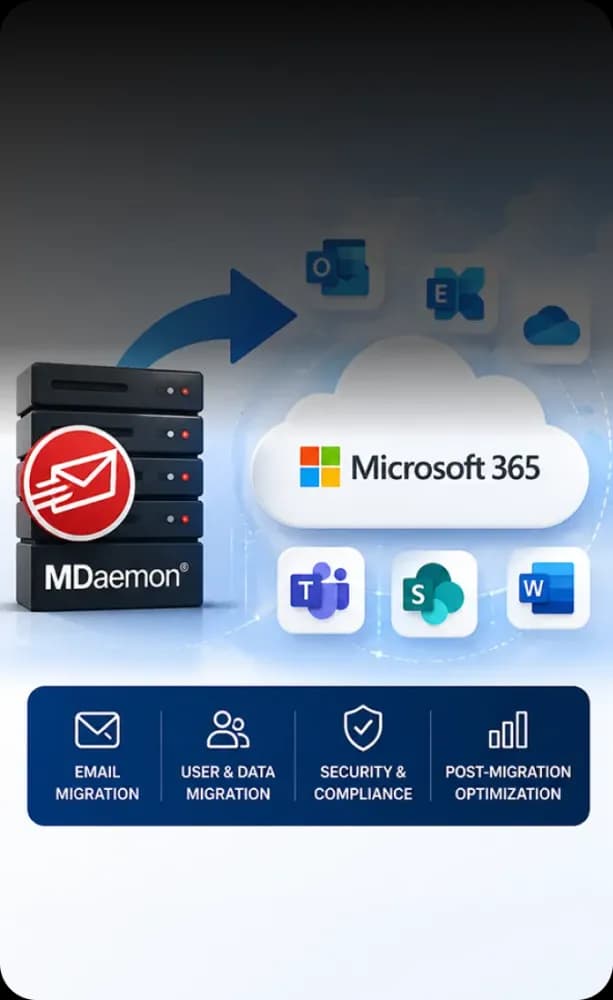
As businesses evolve in a cloud-first, AI-driven environment, traditional email servers are increasingly becoming difficult to manage, scale, and secure. Many organizations using MDaemon are now transitioning to modern cloud platforms like Microsoft 365 to improve collaboration, enhance security, and reduce operational overhead. Migrating from MDaemon to Microsoft 365 is not just a technical upgrade—it is a strategic move toward digital transformation. With the right migration approach, businesses can ensure minimal downtime, data integrity, and long-term cost efficiency. In this guide, we’ll explore the complete migration strategy, cost considerations, and potential risks involved in moving from MDaemon to Microsoft 365 in 2026.
MDaemon is a popular mail server solution known for its reliability and security features. However, as businesses expand and require more collaborative tools and scalability, many are opting to migrate to Office 365. Office 365, now part of Microsoft 365, offers a comprehensive suite of productivity tools, including Exchange Online for email hosting.
Modern businesses require more than just email hosting. Microsoft 365 provides an integrated ecosystem that enhances productivity and scalability.
A successful migration starts with careful planning and assessment.
Migrating to Microsoft 365 involves both direct and indirect costs.
1. Licensing Costs
Microsoft 365 subscription plans based on user requirements
2. Migration Tools & Services
Third-party tools or professional service fees
3. Infrastructure Savings
Reduced hardware, maintenance, and IT overhead
4. Productivity Gains
Faster collaboration and workflow automation lead to ROI
1. Data Loss
Mitigation: Perform full backups and validation before migration
2. Downtime
Mitigation: Schedule migration during off-peak hours
3. Compatibility Issues
Mitigation: Test migration with pilot users
4. Security Gaps
Mitigation: Implement security policies and MFA before migration
5. User Adoption Challenges
Mitigation: Provide training and onboarding support
At Infospica, we provide end-to-end cloud migration services tailored to your business needs. From initial assessment to post-migration optimization, our experts ensure a seamless transition with minimal disruption.
Our approach focuses on:
Migrating from MDaemon to Microsoft 365 in 2026 is more than a system upgrade—it’s a strategic move toward a smarter, more secure, and scalable business environment.
By following a structured migration strategy, understanding cost implications, and mitigating risks effectively, organizations can unlock the full potential of cloud-based productivity.
If you’re planning to modernize your email infrastructure, now is the right time to make the shift.