Written By Sukanya Sathyan
Published on: November 11, 2026
AI has evolved from providing answers to simple queries to providing more complex answers to more complex queries, to providing recommendations for action, and finally to taking action on behalf of humans in order to achieve a desired outcome. This last category of AI, Agentic AI, is enabling organizations to automate workflows and make decisions in order to drive increased efficiency. Such systems are enabling organizations to increase efficiency and allow employees to concentrate on higher value activities.However, with systems able to act on behalf of a business, the question of how much authority to give such systems needs to be addressed.
When AI systems can take action on behalf of a business, how much authority should they have?
The answer to this question involves a number of factors, including business accountability, operational risk, financial controls, and the need for human oversight.
The ability to automate decisions does not mean every decision should be automated without restrictions.
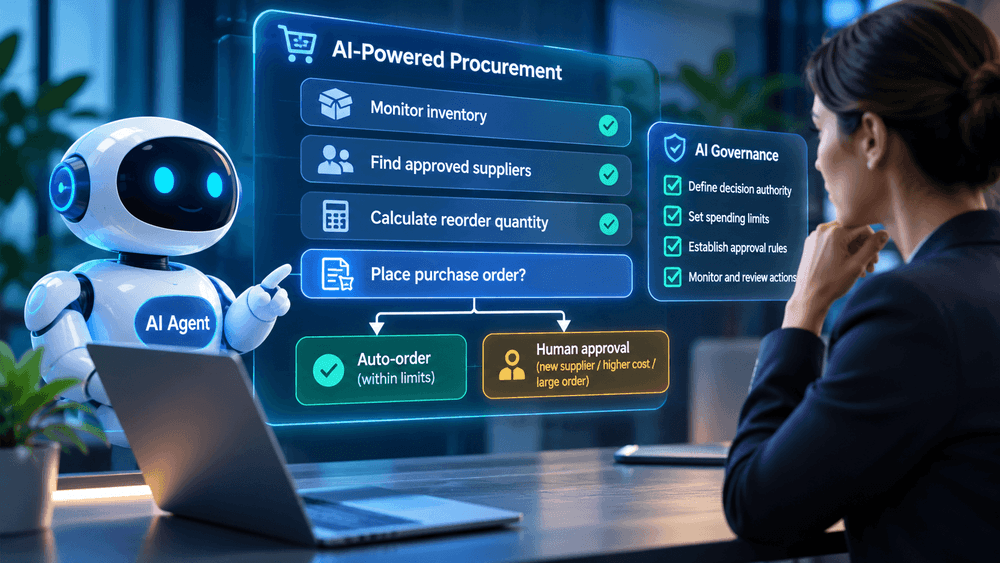
An organization can grant the AI agent permission to reorder regularly purchased materials from approved suppliers, as long as the prices and quantities are within certain parameters.
But what happens when the agent encounters an unfamiliar supplier, a sudden price increase, or an unusually large order?
These situations may require additional evaluation before proceeding. Autonomous systems, if left to operate without boundaries, could create financial, operational, or compliance risks for the business.
Therefore, businesses need to define the situations where the AI agent can act independently and the situations where it needs to seek human approval. The objective is not to eliminate autonomy. It is to ensure that automation operates within an acceptable level of business risk.
One of the concerns of many organizations looking to implement more autonomous systems is the requirement for human review of every decision made by the AI.
Although this approach may appear safer, requiring approval for every routine task can reduce the efficiency benefits of automation. A more practical approach is risk-based human oversight.
Low-risk, repetitive activities can be automated within predefined conditions, while higher-risk or unusual transactions can be escalated to the appropriate decision-makers.
For instance, an AI procurement agent could follow a workflow in which:
This approach allows businesses to benefit from AI-driven efficiency without surrendering control over important decisions.
Implementing an AI agent involves technical decisions such as selecting models, integrating APIs, defining workflows, and establishing system permissions.
However, technology teams should not be solely responsible for deciding how much authority an AI agent receives. Different departments understand different aspects of business risk.
Procurement teams understand supplier relationships and purchasing procedures. Finance teams understand expenditure controls and approval requirements. Compliance teams assess regulatory obligations, while business leadership determines acceptable levels of operational risk. Effective AI governance requires these perspectives to work together.
Before deploying autonomous workflows, organizations should establish clear answers to several questions:
What decisions can the AI agent make independently?
The organization must define which activities can be automated and the limits of that authority.
When should the agent request human approval?
Escalation conditions should be based on financial exposure, business impact, unusual circumstances, and other relevant risks.
How will the agent's actions be monitored?
Businesses need visibility into the actions performed, information used, approvals obtained, and outcomes generated.
Who is accountable when something goes wrong?
Clear ownership, incident-handling procedures, and mechanisms for correcting or reversing actions are essential.
These decisions create the foundation for responsible enterprise AI adoption.
Successful AI adoption requires more than deploying capable models or automating individual tasks. Organizations should evaluate how autonomous actions fit into existing processes, controls, and business objectives.
A practical approach to implementation is to first identify suitable workflows and to assess the impact of the decisions to be automated. Then, we can establish the necessary permissions, spending limits, approval checkpoints, and the escalation procedures.
Technical safeguards are equally important. These may include role-based access controls, transaction validation, activity logging, and monitoring for unexpected behavior.
In addition, organizations must test their AI agents under realistic conditions before granting them broader operational authority. Starting with limited permissions and expanding autonomy gradually allows teams to evaluate performance, identify weaknesses, and refine governance practices. Most importantly, AI systems should remain subject to ongoing review as business requirements, risks, and operating conditions change.
As AI agents become capable of executing increasingly complex business processes, organizations will need to rethink how decisions are delegated across people and technology.
The real opportunity is not simply to automate more activities. It is to create intelligent workflows in which routine decisions can happen efficiently, while sensitive actions remain subject to appropriate controls.
The trust and accountability can be achieved by establishing clear governance frameworks for the autonomous systems. The future of agentic AI will depend not only on how intelligent the systems are but also on how responsible the organization is in using them.
At Infospica, we recognize that effective AI adoption requires alignment between technology capabilities and business objectives. We offer a range of artificial intelligence services to help organizations implement intelligent automation, AI-powered applications, and other solutions to address operational challenges.
Explore Infospica’s Artificial Intelligence Services and discover how our solutions can help you on your digital transformation journey.